
How to Choose the Right Failure to Launch Program for Your Young Adult
Knowing how to choose the right failure to launch program is one of the most important decisions a family can make, and the stakes are real. A striking 69% of students say they have mental health issues, but only 43% of parents believe their child is struggling, according to a 2026 UnitedHealthcare report. That gap alone explains why so many young adults fall through the cracks and why choosing the right support structure matters so much.

Key Takeaways
- Failure to launch syndrome is a real, recognized pattern where young adults struggle to transition into independence due to anxiety, depression, motivation barriers, or social deficits.
- The right failure to launch program should address the root causes of avoidance, not just surface-level behaviors.
- Look for programs that operate in real-world settings, not just clinical or highly controlled environments.
- Academic integration, individual therapy, and 24/7 mentor support are key pillars of an effective program.
- Family involvement in the therapeutic process can significantly improve outcomes for young adults.
- A relationship-based model matters: students build independence through meaningful interpersonal connections, not just structured tasks.
- Programs near accredited colleges give students practical accountability without unnecessary stigma.
What Is Failure to Launch Syndrome and Why Does It Require Specialized Support?
More Than Just "Not Growing Up"
Failure to launch syndrome is not laziness. It is a complex pattern of avoidance, anxiety, and dependency that prevents young adults from stepping into the responsibilities of adult life.
These young adults often want to move forward. The barriers holding them back are emotional and relational, not a lack of intelligence or capability.
Why Generic Programs Often Miss the Mark
Many traditional programs focus on symptoms. They build schedules and enforce rules, but they don't address the underlying relationship dynamics that keep a young adult stuck.
We treat and work on relationship dynamics to help our students remove the barriers that are holding them back from being motivated and becoming independent. That process-focused approach is what separates effective programs from the rest.
How to Choose the Right Failure to Launch Program: The Core Questions to Ask
Does the Program Address the Real Barriers?
Start here. A strong failure to launch program should be asking: what is actually stopping this person from moving forward? Is it anxiety? Social avoidance? Gaming dependency? Family dynamics? Untreated ADHD?
If a program can't articulate how it addresses motivation barriers specifically, keep looking.
Is There Clinical Therapeutic Support Built In?
Individual therapy and group therapy are non-negotiable components. Your student should have access to a therapist who knows them, not a rotating roster of clinicians.
Weekly group therapy sessions allow students to process their real-life challenges in a supported setting, in the moment, as they happen. That timing matters more than most families realize.
Is the Setting Real-World or Controlled?
This is one of the most underappreciated questions when choosing the right failure to launch program. Programs for young adults that operate in highly controlled, residential-only environments often produce students who can function within the program but struggle to translate that success into real life.
Independent living in an academically oriented, supportive community provides students with real-life opportunities and challenges, without the stigma of being a "treatment person." That distinction changes everything.
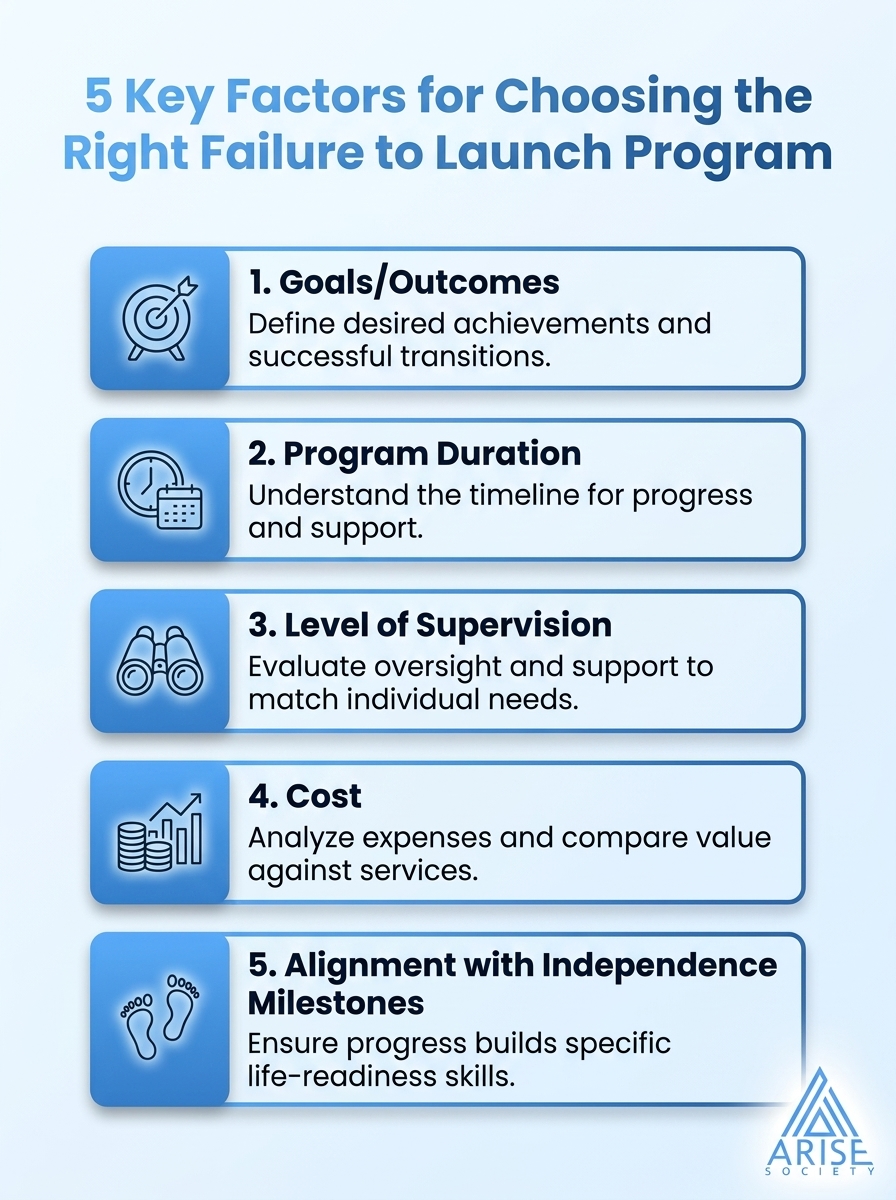
Explore the five factors to help you choose the right Failure to Launch Program. This infographic breaks down the key considerations at a glance.
The Role of Relationship-Based Support in Choosing the Right Program
Why the Model Behind the Program Matters
Our mission is to utilize our unique, relationship-based approach to provide the highest level of personalized care for our students who receive community and therapeutic support in areas of productivity, executive functioning, and social development.
That is not a tagline. It is a clinical philosophy. Programs built around a free-choice model allow students to make real decisions and then process those decisions therapeutically, rather than just complying with a rigid structure.
Mentors and Availability
Round-the-clock mentor support is not about surveillance. It is about being present during the moments when challenges actually arise: late nights, social friction, academic stress, and the quiet moments of self-doubt.
Being in the student's space, in real time, allows mentors to identify patterns and intervene in ways that a weekly check-in appointment simply cannot replicate.

Choosing the Right Failure to Launch Program for Neurodivergent Young Adults
Autism and ADHD Require Specialized Attention
If your young adult is autistic or has ADHD, a generalist program is rarely enough. These students need clinicians who understand how executive functioning deficits, social communication differences, and sensory factors intersect with motivation barriers.
At The Arise Society, we added young adult males with autism to our specialty because we recognized how underserved this population was in transitional settings. Clinical experience with this group is not something a program can fake.
What to Look for in Clinical Staff
Ask about the therapeutic orientations the clinical team uses. Individual therapy, group therapy, and structured family involvement should all be present. Programs that offer individualized medication management plans show they are paying attention to the full picture of each student's health.
Strong programs also provide therapeutic parent support. Family dynamics and failure to launch are deeply connected. Ignoring the family system rarely leads to lasting change.
Academic Integration: A Factor Most Families Overlook When Choosing the Right Program
College as the Therapeutic Arena
One of the strongest indicators of a quality failure to launch program is whether academic engagement is built into the treatment model, not treated as a separate goal.
Students at The Arise Society attend Utah Valley University, located within 500 feet of their residence. That proximity is intentional. College attendance becomes the daily proving ground for the skills students are building in therapy and mentorship.
Academic Support That Goes Beyond Tutoring
Highly personalized academic plans, weekly academic meetings, supervised study hall, and transparency of grades are all features that separate a real academic support structure from a vague commitment to "educational goals."
Open enrollment options like UVU remove barriers like SAT or ACT scores, which allows students who have been out of the academic track to re-enter without additional shame or gatekeeping.
Building Skills Through Real Accountability
We guide our students toward independence through the development of meaningful, interpersonal relationships. Academic accountability is part of that: showing up to class, completing coursework, and managing deadlines are relationship-driven behaviors, not just study skills.

How to Evaluate Social Support Structures in a Failure to Launch Program
Community Is Not Optional
Social isolation is one of the most common features of failure to launch syndrome. The right program does not just offer social activities as an add-on. It builds a community structure where social development is actively supported and therapeutically processed.
We emphasize the importance of forming and developing social preferences in order to avoid the typical "program" dogma that everyone should be close to everyone. Real friendships have nuance. A good program respects that.
Activities That Build, Not Distract
Weekly community-wide activities, student-organized small group events, and optional trips between semesters all serve a clinical purpose. They give students low-stakes opportunities to practice social skills in contexts that actually matter to them.
Check whether a program's activities are structured with therapeutic intent or just scheduled to fill time. That difference is easy to spot when you ask the right questions.
Red Flags to Watch for When Comparing Failure to Launch Programs
Warning Signs That Suggest a Poor Fit
Not every program is built with the student's actual independence as the goal. Here are patterns worth watching for:
- No clear clinical model. If a program can't explain its therapeutic approach in concrete terms, that is a problem.
- Highly controlled environments with no real-world integration. Students transitioning out of highly controlled or structured therapeutic settings may have difficulty translating their success into real life.
- No family involvement component. A program that sidelines parents entirely misses a significant piece of the equation.
- No academic component. Life skills alone do not build independence. Education and vocational progress are part of the picture.
- No 24/7 mentor access. Challenges don't follow a 9-to-5 schedule. Neither should support.
- One-size-fits-all programming. Each student's barriers are different. A program should be able to customize a success plan to your student's specific needs.
Questions to Ask During an Admissions Call
- How do you assess what is holding a student back from being motivated?
- What does a typical week look like for a student in your program?
- How is family involved in the therapeutic process?
- What happens if a student is struggling academically after enrollment?
- How do you address technology addiction and failure to launch patterns?
- What does your discharge and transition planning look like?
Is The Arise Society the Right Fit for Your Student?
Who We Help
We work best with young adults between the ages of 18 and 26 who are seeking college or vocational education, struggling with anxiety, depression, or trauma, and dealing with difficulties around focus, motivation, or social development.
We also specialize in students with learning differences including ADD/ADHD and NVLD, as well as mild to moderate social deficits. Students with active chemical dependency or substance addiction are not a fit for our model. We are direct about that because it matters for the student's safety and the integrity of our community.
What Makes Our Approach Different
At The Arise Society, we don't just build self-esteem; we help our students find the motivation to become mature, self-aware, and effective communicators. Our integrated, community approach allows us to fully assess and understand our students' life skills development, strengths, and struggles.
No One Else Does What We Do, The Way We Do It. That is not a claim we make lightly. It reflects a program model built over decades of clinical experience with the specific population of young adults who struggle most with the transition to independence.
Families considering failure to launch programs for young adults can learn more about our student profile and whether our community is the right match. The right placement requires honesty on both sides.
Conclusion: How to Choose the Right Failure to Launch Program
Choosing the right failure to launch program starts with one honest question: does this program address the actual barriers to independence, or does it just manage behavior? The answer shapes everything that follows.
The best programs operate in real-world settings, build independence through relationship, and integrate academic accountability with clinical support. They involve families. They customize plans. They are available when things get hard, not just during scheduled sessions.
If your young adult is struggling with failure to launch syndrome, the path forward is not waiting for motivation to appear on its own. It is finding a program with the structure, the clinical depth, and the human connection to meet them where they are and walk alongside them as they grow.
We are more than a mission. We are a movement. Learn who we help and reach out to see if The Arise Society is the right next step for your family.
Frequently Asked Questions
What should I look for in a failure to launch program?
Look for programs that combine clinical therapy, real-world academic integration, and 24/7 mentor support in the same setting. The best failure to launch programs address the underlying motivational and relational barriers, not just the surface-level behaviors.
How do I know if my young adult has failure to launch syndrome?
Common signs include persistent avoidance of adult responsibilities, difficulty maintaining employment or education, social withdrawal, and heavy reliance on parents for daily functioning. Breaking the failure to launch cycle typically requires professional support, not just encouragement at home.
Is a failure to launch program worth it in 2026?
Yes, particularly for young adults with untreated anxiety, depression, ADHD, or autism. In 2026, the demand for structured transitional support has grown significantly as college dropout rates and mental health challenges among young adults continue to rise. A well-matched failure to launch program provides the safety net the first year of independence genuinely needs.
What is the difference between a transitional living program and a failure to launch program?
A transitional living program focuses primarily on housing and life skills during the move to independence. A failure to launch program is broader: it includes clinical therapy, academic support, social development, and ongoing mentorship, all integrated into a real-world setting designed to build lasting independence.
How long does a failure to launch program typically last?
Most structured programs run approximately one year, which aligns with completing a full academic cycle. That timeline allows students to build real-world skills across multiple semesters and address both the practical and therapeutic dimensions of independence without rushing the process.
Can a failure to launch program help with gaming addiction or technology overuse?
Yes. Technology dependency is one of the most common factors present in failure to launch syndrome in 2026. Programs that understand how digital avoidance intersects with motivation barriers are better positioned to address this pattern directly rather than just restricting screen time.
What role should family play in a failure to launch program?
Family involvement is a clinical necessity, not an optional extra. Family dynamics directly influence failure to launch patterns, and the best programs provide therapeutic parent support alongside student treatment. Without addressing the family system, progress often stalls when the student returns home.